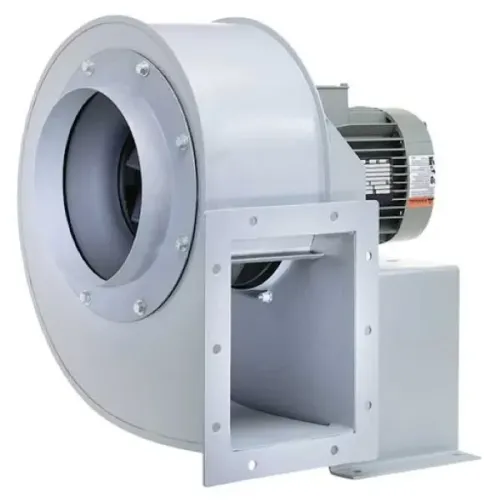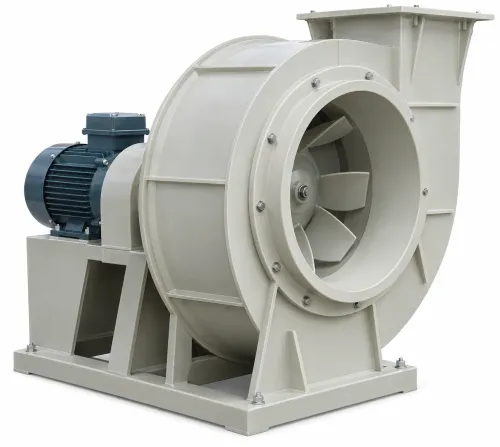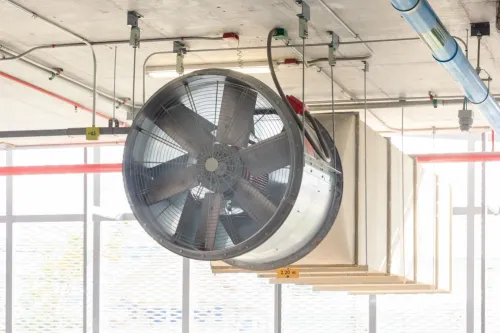


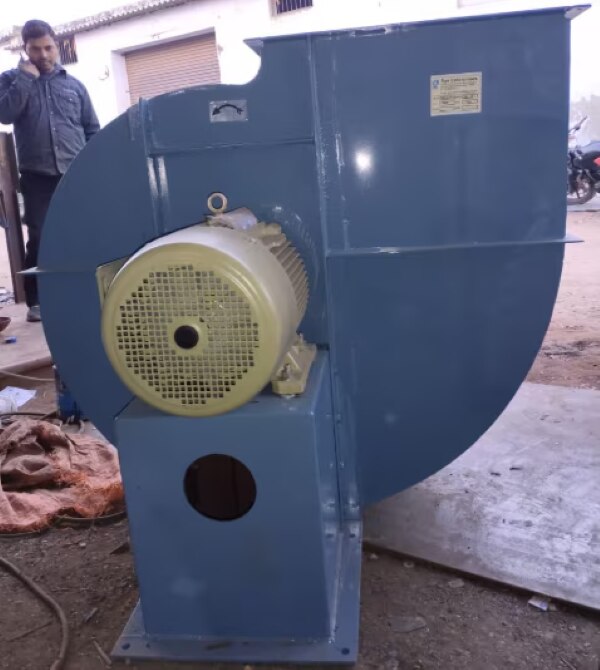
An FD fan pushes air into a furnace, while an ID fan pulls flue gas through the furnace, heat-recovery equipment and pollution controls before discharge. Understanding that opposing airflow path lets you set furnace pressure, specify the correct duty point and avoid selecting a fan from airflow or motor size alone.
Key takeaways
- FD fans push combustion air into the furnace; ID fans pull flue gas toward the stack.
- Using both fans helps maintain furnace pressure near the intended operating condition.
- Specify ID fans by flow, pressure, gas temperature, composition and duty point.
- Compare fan arrangements by control method, power demand, maintenance access and leakage risk.
How FD and ID Fans Move Air Through a Process
Air enters the FD fan from the plant or outdoors, while the ID fan draws combustion gases toward the stack. These process airflow fans create two linked paths: one pushes clean air into the furnace, and the other pulls hot flue gas through it and the exhaust-treatment equipment.
1. The FD fan draws ambient air and pushes it through dampers, an air heater, the windbox and burners. The air heater can raise its temperature before the burners mix it with fuel.
2. Combustion occurs in the furnace or boiler firebox. The resulting flue gas carries heat, ash and combustion products through the furnace passes.
3. Gas then flows across heat-recovery surfaces such as superheaters, economizers or air heaters. Each surface removes heat but adds resistance to the gas path.
4. The gas passes through pollution-control equipment, including a baghouse, electrostatic precipitator or scrubber. Dampers and connecting ducts add further pressure loss.
5. The ID fan pulls the treated gas through that entire downstream system and discharges it into the stack. Its suction helps keep the furnace and ductwork slightly below atmospheric pressure, so leakage moves inward instead of forcing hot, dusty gas into the building.
FD fans normally handle cleaner, cooler air than ID fans. ID fans and FD fans therefore move related flows but face different pressure, temperature and contamination duties. A loss of ID-fan flow can also remove furnace containment, triggering fuel isolation and purge safeguards rather than a simple airflow reduction.
Why Boilers Use Both Fans to Control Furnace Pressure
An FD fan supplies combustion air into the windbox and burners; an ID fan pulls flue gas through the furnace, heat-recovery surfaces, pollution-control equipment and stack. Running both creates a controlled pressure balance instead of forcing gas through the boiler from one end.
The ID fan regulates furnace pressure, usually keeping it slightly negative. That pressure makes air leak inward through doors, seals and casing joints, rather than allowing hot gas, dust and pollutants to escape into the boiler house. Containment is one of the main ID fan benefits.
The FD fan controls the air available for combustion, while the ID fan removes the resulting gas and overcomes downstream resistance. Coordinate their controls as a pair:
- Adjust FD output to maintain combustion-air flow or windbox pressure.
- Adjust ID output to maintain the furnace-pressure setpoint.
- Tune the two loops to prevent oscillating draft, excess oxygen and unstable flames.
- Interlock fuel admission with loss of draft, fan availability and required purge conditions.
- Test the response to an ID fan trip, because losing it can produce a rapid positive-pressure excursion rather than merely reducing airflow.
A stack alone cannot reliably maintain this balance across firing rates, fouled heat-transfer surfaces or changing gas resistance. If the FD fan runs without matching extraction, the furnace can pressurise; if the ID fan over-pulls, excess air enters through leaks and raises fan power and oxygen losses.
Together, the fans keep pressure and combustion flow within their intended operating ranges.
The Service Conditions and Trade-Offs of ID Fan Operation
An industrial ID fan operates on the dirty side of the process, pulling flue gas through the furnace, heat-recovery surfaces and pollution-control equipment. Its main ID fan benefits are containment and cleaner surroundings: slight negative pressure draws air inward through small leaks instead of pushing hot gas, dust and pollutants into the building.
An FD fan usually handles cleaner ambient or preheated air and pushes it into the furnace.
| Service condition | FD fan | ID fan |
|---|---|---|
| Temperature | Near ambient or preheated combustion air | Hot flue gas; maximum-temperature sizing matters |
| Pressure duty | Supplies furnace and burner pressure | Overcomes the full downstream system pressure drop |
| Dust and solids | Usually low particulate loading | Ash, abrasive dust, droplets or sticky deposits |
| Corrosion | Lower chemical exposure | Acid gases, moisture and condensables can attack metal |
Hot gas also occupies more volume than the same mass of cool air. Specify ID-fan flow at actual inlet temperature, pressure, moisture and gas composition, not only at standard conditions, or the inlet and impeller can be undersized.
Require these design cases:
- Maximum gas temperature and dirty-system pressure drop
- Dust loading, corrosive constituents and expected fouling
- Turndown range, allowable leakage and sound limit
- Wear liners, corrosion-resistant materials, drains, shaft sealing and cleaning access
An ID fan installed after a scrubber or filter preserves negative pressure through that equipment, but residual particles, outlet temperature and chemical species still determine erosion, corrosion and maintenance cost.
How to Specify and Compare an ID Fan Duty Point
An ID fan duty point is meaningful only when you compare the same gas flow, pressure basis and worst operating condition. Specify mass flow and actual volume flow, because hot flue gas occupies far more volume than ambient FD-fan air.
| Fan | Inlet condition | Pressure duty |
|---|---|---|
| ID fan | Hot gas after the furnace, heat recovery and pollution-control equipment | Ducts, air heater, scrubber, baghouse or precipitator, dampers and stack, including dirty-condition losses |
| FD fan | Ambient or preheated combustion air before the furnace | Burner, windbox, air heater and upstream duct losses |
| Comparison basis | The selected operating case | Static or total pressure, gas temperature, elevation, moisture and density stated explicitly |
Ask for these operating inputs:
- Minimum, normal and maximum mass flow, plus actual volume flow at the fan inlet
- Clean and fouled pressure drops for every downstream component
- Gas temperature range, dust loading, moisture, corrosive constituents, leakage allowance and sound limit
- Turndown range, furnace-pressure target, combustion-air requirement and pollution-control operating limits
Then plot each duty point on the manufacturer’s fan curve. Check that the selected point lies in the stable region, not near stall, surge or the curve’s shutoff edge, and verify brake horsepower, motor service factor, speed, bearing limits and fan efficiency.
Do not compare ID fans and FD fans by horsepower or nominal airflow alone. A variable-speed ID system can avoid damper losses, but confirm minimum speed, motor cooling, combustion stability and pollution-control performance at turndown. These checks give process airflow fans a like-for-like lifecycle comparison.
Choosing the Arrangement and Managing Its Operating Cost
Choose an ID-and-FD arrangement when preventing outward leakage matters more than the extra equipment and energy: the ID fan holds the furnace slightly negative, while the FD fan supplies controlled combustion air. This suits boilers, furnaces and processes releasing hot dust, corrosive gas or pollutants inside occupied buildings.
| Option | Pressure result | Cost and maintenance consequence | Best fit |
|---|---|---|---|
| FD-only | Equipment tends toward positive pressure | Cleaner fan service, but fugitive gas and dust can escape | Clean processes where containment is not critical |
| ID-only | Draft depends on one fan and leakage paths | Simpler arrangement, but combustion-air control is limited | Small or stable duties with modest control demands |
| ID plus FD | Furnace pressure and air supply are controlled separately | Higher capital cost, but better containment and process control | Variable-load, high-temperature or pollution-controlled processes |
Use variable-speed drives when airflow changes; reducing speed avoids the throttling loss of a damper-only system. Do not run below the speed needed to prevent stall, maintain motor cooling, satisfy combustion requirements and keep the pollution-control equipment within its operating range. Poor coordination produces excess oxygen, unstable combustion or positive furnace pressure.
During operation and maintenance, verify:
- Furnace pressure trend, FD airflow or windbox pressure, and ID-fan speed.
- Fan current, vibration, bearing temperature and abnormal noise.
- Impeller wear, ash buildup, sticky deposits, corrosion, casing drains and shaft seals.
- Actual gas temperature and pressure drop across the air heater, dust collector and scrubber.
When comparing a supplier such as Sys Enterprises, request the fan curve at actual gas density plus impeller material, wear allowance, access provisions and cleaning requirements.
Related products
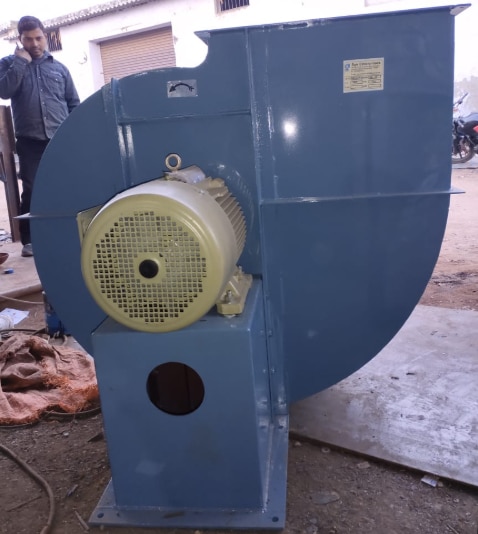 | ID & FD Fans Sys Enterprises manufactures robust and high-efficiency Induced Draft (ID) and Forced Draft (FD) Fans for industrial boiler and process applications. View product → |
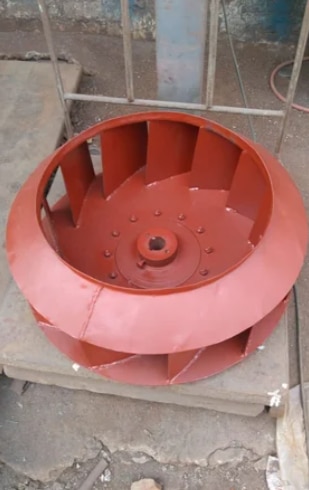 | Axial Flow Fans ₹5000 High-Quality ID Fan Impellers Manufacturer & Supplier We are a trusted manufacturer and supplier of ID Fan Impellers (Induced Draft Fan Impellers),... View product → |
Frequently asked questions
What is the difference between an ID fan and an FD fan?
An FD fan forces clean air into the furnace, while an ID fan draws combustion gases through the boiler, treatment equipment and stack.
Why do boilers use both FD and ID fans?
The two fans control the balance between incoming combustion air and outgoing flue gas, helping maintain the required furnace pressure.
What information is needed to specify an ID fan?
Define the gas flow, static pressure, temperature, gas composition, dust loading, altitude, operating range and required duty point.
What should you compare when choosing an ID fan arrangement?
Compare fan efficiency, speed control, inlet and outlet conditions, maintenance access, corrosion and erosion exposure, leakage, redundancy and operating cost.