A direct-drive tube axial exhaust fan connects its motor directly to the impeller, but that simple arrangement does not determine whether the fan will meet your airflow, pressure, temperature or hazardous-duty requirements. By the end, you will know how to read the specifications, match the fan to the system, verify installation details and write a purchase enquiry that suppliers can quote accurately.
Key takeaways
- Select the duty point where airflow and pressure intersect on the fan curve.
- Direct drive removes belts, sheaves, slip and belt-alignment maintenance.
- Specify air temperature, contaminants, motor rating, rotation and installation orientation.
- Request the fan curve, dimensional drawing, motor data and test documentation.
What the direct-drive tube axial arrangement includes
Direct drive means the motor shaft or rotor assembly connects directly to the impeller hub. An industrial tube axial exhaust for direct drive therefore has no belts, sheaves, belt slip, alignment work or belt replacement.
Bearing and motor maintenance remain, and removing the combined motor-impeller assembly can require more lifting and access space than servicing a belt drive.
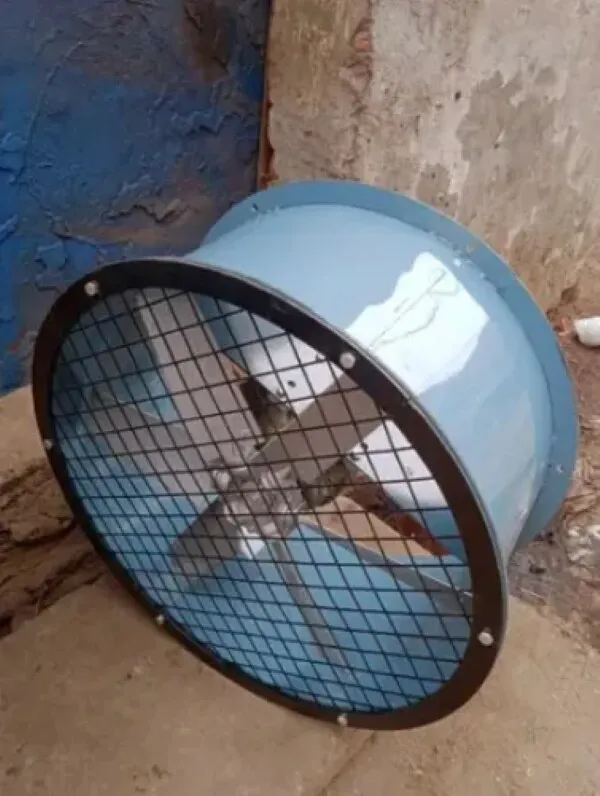
The arrangement includes a cylindrical tube casing, inlet, outlet, impeller hub, motor mount, guards and service access points. Confirm whether the motor sits in the airstream on a strut or spider mount, or outside it in a separate support arrangement; that choice affects obstruction, cooling and maintenance.
Request these industrial axial exhaust specifications:
- Airflow in m³/h or CFM, identified as actual or standard volume; fan static pressure, fan total pressure or system static pressure in Pa or mmWG.
- Wheel diameter, blade count and blade geometry; speed in RPM; rotation; efficiency; and duty cycle.
- Motor power in kW or HP; voltage, phase and frequency; speed-control method; and bearing arrangement.
- Air temperature, density, elevation and gas composition; sound level with its test basis; and construction materials or coating.
- Guard construction, access requirements, and vibration or balance grade, such as AMCA 204 or an equivalent practice.
A direct drive tube axial fan is not defined by diameter alone. At 60 Hz, a four-pole motor runs near 1,800 RPM and a two-pole motor near 3,600 RPM before slip; the selected impeller, duty, sound, vibration and motor load must match that speed.
How to select the duty point from the fan curve
Select the duty point where the required airflow meets the complete system-resistance curve, not where the fan shows its free-air rating. Free-air volume is measured at near-zero pressure; rated airflow is the volume delivered at a stated fan static pressure, fan total pressure or system static pressure.
Plot actual airflow in m³/h or CFM against that pressure, using the same air density and temperature. These industrial axial exhaust specifications prevent a fan selected by airflow alone from stalling under load.
Build the resistance curve from every item the air must pass:
- Duct length, elbows, abrupt transitions, louvers, filters, dampers, grilles and screens
- Discharge obstructions and inadequate straight duct
- System effect from an elbow placed directly at the inlet, which disturbs the entering velocity profile and reduces delivered airflow
A direct drive tube axial fan removes belts and sheaves, but speed changes are less convenient and removing a heavier motor-impeller assembly can take longer. For geometrically unchanged tube axial exhaust fan details in the same air density, airflow varies approximately with speed, pressure with speed squared and power with speed cubed.
Recheck motor load after changing speed or impeller diameter.
| Option | Pressure capability and airflow behaviour | Footprint, access and maintenance |
|---|---|---|
| Plain tube axial | High airflow at low-to-moderate pressure; more sensitive to resistance | Compact; direct-drive access depends on motor and guard removal |
| Vane axial | Higher pressure capability and steadier flow | Longer casing; guide vanes add inspection points |
| Centrifugal | Better for high pressure, filters and complex ducting | Larger footprint; heavier wheel and housing |
| Roof exhaust | Suits short, low-pressure discharge paths | Roof access governs service |
| Belt-driven axial | Convenient speed changes and motor access | Requires alignment, tensioning and belt replacement |
When direct drive is suitable—and when the environment changes the design
Direct drive suits general exhaust, heat removal and process ventilation when the duty does not demand high static pressure, precise flow control, filtration or heavy particulate handling. It is preferable where access is limited, belt contamination is likely, alignment consumes time or belt replacement would stop production.
Belt drive remains useful when speed adjustment and service access matter more than eliminating belts.
1. Use a VFD only after checking the motor nameplate: voltage, phase, frequency, rated power, service factor and enclosure. Confirm the minimum stable speed, motor cooling at reduced speed, allowable frequency range, prohibited resonance bands, fan stall behaviour and the system’s minimum ventilation requirement. A VFD cannot safely create unlimited turndown.
2. Treat dust, corrosive vapour, combustible gas and spark-producing contaminants as design inputs. A standard direct-drive tube axial fan is not automatically suitable for a hazardous location; an explosion-proof motor does not certify the wheel, hub, casing, fasteners or clearances. Identify the area classification and obtain documented electrical and mechanical compliance before purchase.
3. Match the casing, wheel, guards and fasteners to humidity, corrosion, high temperature, condensation and washdown exposure. If the motor sits in the airstream, gas temperature, moisture, corrosive constituents and dust loading become motor-selection issues as well as material issues.
These tube axial exhaust fan details determine service life, not diameter alone: abrasive dust erodes blades, sticky fibres unbalance the wheel and condensation damages bearings or insulation. Choose a different fan arrangement when filtration, high pressure or difficult solids handling dominates the duty.
Installation, commissioning and maintenance checks that protect performance
Install the fan in the marked airflow direction, with the motor and impeller orientation matching the drawing. Use flexible connectors to absorb movement, but keep them taut enough to prevent collapse; isolate the casing and supports from structure-borne vibration.
1. Provide gradual duct transitions, not abrupt reducers, and leave straight clearance at the inlet and discharge. Keep walls, elbows, screens, dampers and other obstructions away from these openings; a bend tight against the inlet creates system effect and cuts airflow.
2. Fit guards in their intended positions without blocking the inlet or outlet. Leave removable access for motor, shaft, impeller and bearing service.
3. Before commissioning, confirm rotation against the arrow. Reversed rotation can produce poor airflow, overload or impeller damage.
4. Run the fan at the stated duty and measure actual airflow, pressure, damper position, motor current on every phase, vibration, abnormal noise and operating temperature. Do not commission from free-air airflow alone or treat a tube axial fan like a high-pressure centrifugal fan.
5. Inspect bearing condition, impeller fouling, corrosion, fasteners, guards, electrical terminals, motor cooling passages and drainage at scheduled intervals. Abrasive dust erodes blades; sticky or fibrous material unbalances the wheel, while deposits and corrosion invalidate its original balance.
These tube axial exhaust fan details matter for industrial tube axial exhaust for direct drive: direct drive removes belt work, not motor, bearing, cleaning, balance or access requirements. Condensation and corrosive gases demand suitable materials, coatings and drainage.
How to write the purchase enquiry and verify the supplier’s documents
A purchase enquiry for an industrial tube axial exhaust for direct drive must define the operating point, not just the fan diameter. State airflow in m³/h or CFM, fan static, total or system static pressure in Pa or mmWG, and whether the volume is actual or standard, with air temperature, density, elevation and gas composition.
1. Describe the service: contaminant type and concentration, duty cycle, installation arrangement, airflow direction, access limits, required service conditions, sound limit and test basis. Include diameter, impeller hub and blade geometry, rotation, casing, impeller, guard and fastener materials, coating, and bearing arrangement.
2. State the electrical package: motor voltage, phase, frequency, rated power, speed, control method and VFD range. Identify the hazardous-area classification; “industrial exhaust” is not certification for combustible dust or flammable vapour.
3. Request a performance curve marking your duty point, a dimensional drawing, motor datasheet, wiring diagram, rotation confirmation, balance grade, vibration limits, inspection records and operating instructions. Require testing to AMCA 210 or ISO 5801 where applicable. Sound data must identify the operating point, inlet and outlet arrangement, test method, and octave-band or overall basis.
Reject the fan if the system needs high pressure, filtration, precise turndown, hazardous-area certification or heavy particulate handling. Compare spares, motor and impeller access, cleaning time and downtime; direct drive removes belt work but not service access. Sys Enterprises can be approached when documented industrial airflow and exhaust selection is required.
Related product
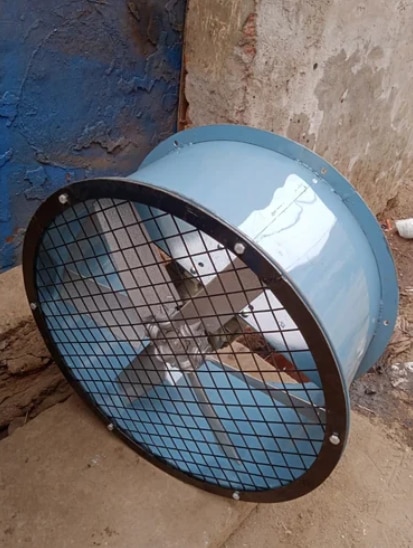 | Axial Flow Fans Industrial Tube Axial Exhaust Fans ₹14000 Industrial Tube Axial Exhaust Fan Manufacturer & Supplier We are a trusted manufacturer and supplier of Industrial Tube Axial Exhaust Fans, offering... View product → |
Frequently asked questions
What does a direct-drive tube axial exhaust arrangement include?
It connects the motor shaft or rotor assembly directly to the impeller hub, eliminating belts, sheaves, belt slip, alignment work and belt replacement.
How do you select the duty point from an axial fan curve?
Identify the required airflow and system pressure, then choose a fan curve operating point that delivers both values within the fan’s stable operating range.
When is direct drive suitable for an industrial tube axial exhaust?
It suits installations that benefit from compact construction and low belt maintenance. Air temperature, corrosive contaminants, dust loading, motor access and hazardous-area requirements can change the design.
What documents should you request before buying a tube axial exhaust fan?
Request the fan curve, dimensional drawing, motor data, materials and coating details, rotation information, sound data, operating limits and performance-test documentation.
Keywords