An air washer can meet its airflow rating and still fail to deliver the required temperature, humidity, filtration, or pollution-removal result. You will be able to turn room, process, water, air-quality, and operating data into a defensible specification, then check capacity, controls, safety, and maintenance before commissioning.
Key takeaways
- Specify entering and leaving psychrometric conditions, not airflow alone.
- Match washer type and filtration to dust, gas, oil, and microbial risks.
- Calculate airflow, water flow, fan duty, tank volume, and access space together.
- Test controls, water quality, hygiene, drainage, and performance before handover.
Define the Air Washer Duty from Psychrometric and Site Data
Provide a design point, not just an airflow figure. Air washer requirements begin with the entering dry-bulb temperature, wet-bulb temperature or relative humidity, barometric pressure or site elevation, airflow, and the required leaving temperature and humidity at the actual operating condition.
1. State how the airflow is determined: room volume and air changes, process exhaust replacement, occupancy, or a measured process demand. Give minimum, normal, and maximum flow if the load varies.
2. Convert the psychrometric targets into capacity. For humidification, calculate evaporation as ṁwater = ṁdry-air × (wout − win), where w is humidity ratio. Do not substitute pump circulation flow for evaporation capacity; recirculated water is far greater than the quantity absorbed by air.
3. Describe the site constraints: operating hours, seasonal conditions, available footprint and height, service access, drain location, water supply, electrical supply, duct arrangement, and allowable noise.
4. Identify every contaminant, its concentration, particle-size distribution or gas solubility, required outlet concentration, and whether the washer serves pollution control rather than comfort conditioning. That distinction changes air washer selection and requires liquid-to-gas ratio, reagent, contact time, pressure drop, and eliminator data.
Specify the fan duty at the wet design condition. Include casing, spray, and eliminator pressure drops, plus fouling allowance; a fan sized on the dry casing can lose airflow after scale or dirt loads the eliminator. Record the permitted carryover limit at design airflow and water condition.
Choose the Washer Type, Filtration Stage, and Contaminant Strategy
Choose by duty, not airflow alone. Air washer selection changes sharply between evaporative comfort conditioning and industrial pollution control.
| Design | Best match | Filtration and contaminant limits |
|---|---|---|
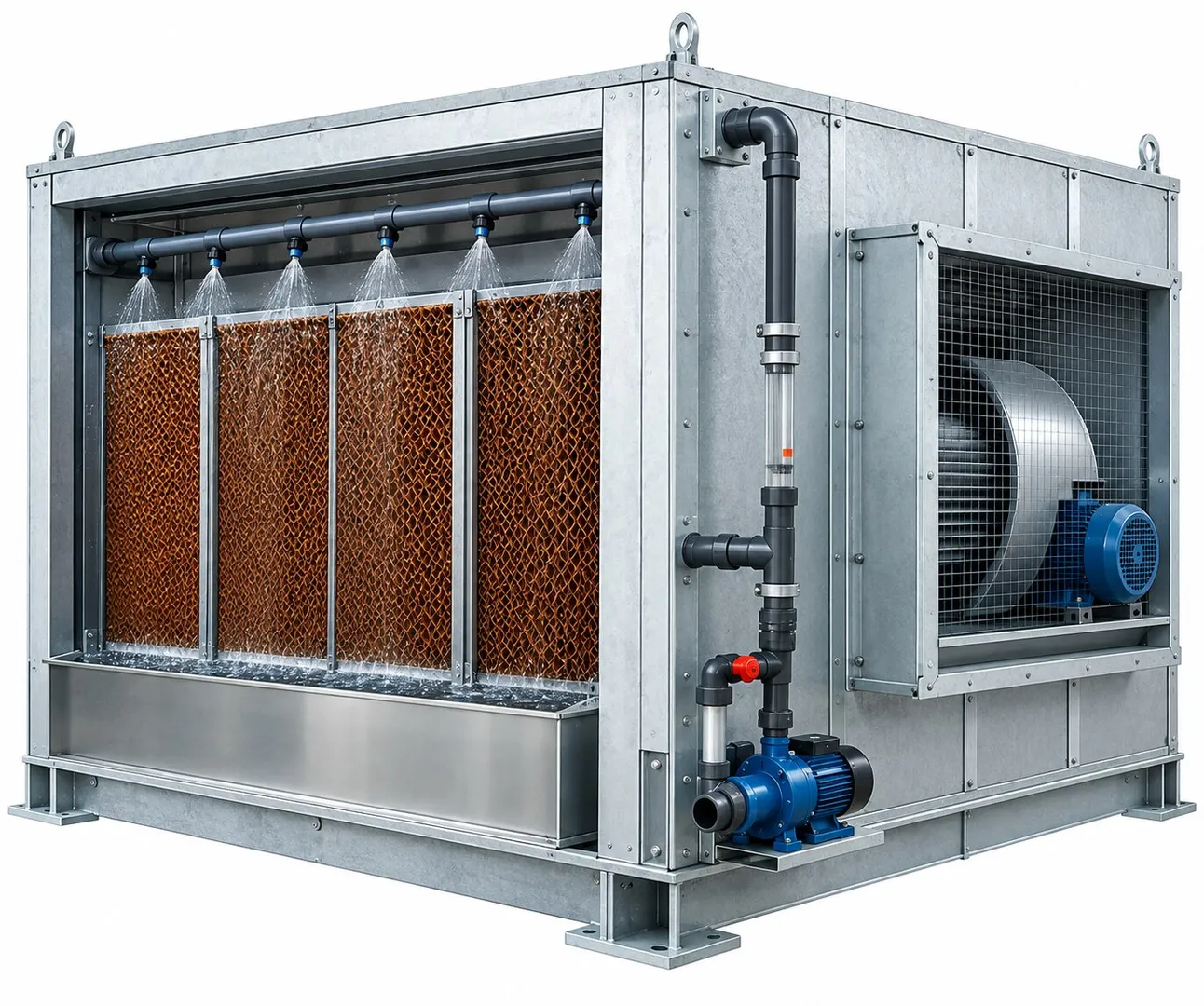
| Spray-chamber washer | High cooling, humidification, and coarse dust removal with adjustable contact time | Add an upstream prefilter for large particles and a downstream eliminator; specify spray pattern, liquid-to-gas ratio, pressure drop, and carryover limit |
| Wetted-pad washer | Efficient evaporative cooling and humidification where water quality and low maintenance matter | Use a prefilter to protect the pad; it is not a substitute for fine-particle or gas treatment |
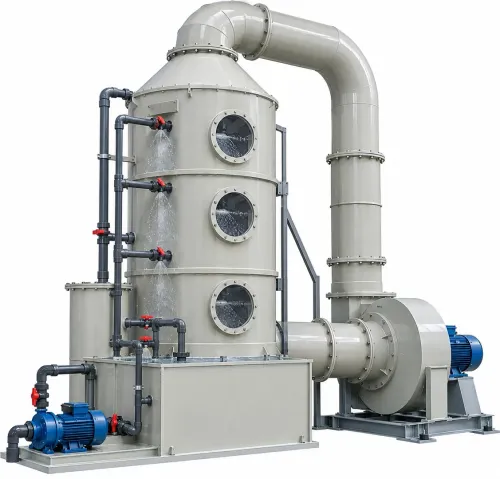
| Scrubber-type industrial air washer | Dust, fumes, or soluble gases from a process exhaust | Select the reagent, contact time, pressure drop, mist eliminator, and outlet concentration for the named pollutant |
A comfort washer does not become a pollution-control system by adding a pump. For dust, obtain the particle-size distribution; for gases, establish solubility, concentration, reagent chemistry, and required outlet limit. Match the unit to duct transport velocity, exhaust-fan material, corrosion risk, stack conditions, and hazardous-area classification.
Use staged filtration: a washable or disposable coarse prefilter upstream, the wet contact stage, then a properly rated fine filter or mist eliminator downstream. Preventing droplets from reaching the duct matters as much as capture efficiency; wet deposits can corrode equipment and obstruct airflow.
Include sump blowdown treatment in the design. Test dissolved solids, chemicals, captured particulate, and absorbed pollutants, then specify drain capacity, neutralization or pretreatment, and lawful disposal. Never send concentrated blowdown to a general floor drain.
Calculate Airflow, Water Flow, Fan Duty, and Physical Capacity
Start with the leaving-air condition, not the fan size: air washer capacity requirements depend on airflow plus the temperature and humidity change the washer must deliver. Air quantity is reported in m³/h or CFM; cooling capacity is reported in kW, and humidification capacity in kg of water evaporated per hour.
Calculate design airflow from the controlling duty, such as room volume × air changes per hour, process exhaust replacement, or occupancy ventilation. Then calculate the moisture addition separately:
ṁwater = ṁdry-air × (wout − win)
Here, w is humidity ratio in kg water per kg dry air. Pump circulation is not evaporation capacity; a spray washer may circulate far more water than the air absorbs.
For air washer selection, document these separate values:
- Design airflow and turndown airflow
- Entering and leaving dry-bulb temperature
- Entering and leaving humidity ratio or enthalpy
- Required sensible, latent, or total cooling in kW
- Required evaporation rate in kg/h
Size the fan for the wet operating resistance, including the washer, droplet eliminator, downstream filters and ducts. Check the fouled condition too; scale on an eliminator can consume the pressure margin that looked adequate with a clean, dry casing.
Size face area from allowable air velocity and select spray or pad area from the manufacturer’s heat and mass-transfer data. Size the sump for pump submergence, usable reserve and drain-down volume, then verify nozzle flow at minimum load so distribution remains stable.
Specify Controls, Water Quality, Hygiene, and Commissioning Tests
A washer that meets its airflow rating can still fail through carryover, stagnant water, or freezing. Set air washer requirements around cleanable, drainable wetted surfaces, access to the sump and eliminator, and no dead legs.
Use treated water with specified hardness, conductivity, chloride, and microbiological limits; control blowdown and document cleaning, disinfection, and Legionella prevention for ongoing air washer operation.
Specify these operating controls:
- Maintain sump level and pump minimum flow; low level must stop the pump.
- Control conductivity with automatic blowdown and make-up water.
- Stage spray banks or vary pump speed so nozzles remain within their stable flow range at low load.
- Interlock the fan, pump, low-temperature trip, and high-water alarm.
- Provide preheat, insulated piping, heat tracing, automatic drain-down, or another freeze-protection sequence for exposed headers, drains, sumps, and low points.
- Make loss of power leave valves and heaters in a safe freeze-protection state.
Record acceptance results at design airflow and water condition:
| Test | Acceptance evidence |
|---|---|
| Airflow and pressure | Design airflow with wet, clean, and fouled pressure-drop allowances |
| Psychrometric duty | Entering and leaving temperature and humidity meet the specified condition |
| Carryover | No water reaches downstream filters or ducts above the stated limit |
| Water system | Pump flow, level, conductivity trip, low-flow trip, and drain-down operate correctly |
| Hygiene and access | Sump and eliminator can be inspected, cleaned, disinfected, and fully drained |
Set Industrial Pollution-Control, Maintenance, and Drainage Requirements
An industrial air washer is suitable for process pollution control only when the supplier sizes it as a scrubber, not as a comfort-humidification unit. The specification must state the pollutant, particle-size distribution or gas solubility, inlet load, outlet concentration, liquid-to-gas ratio, contact time, reagent chemistry, pressure drop, and mist-eliminator performance.
Use this procedure to set the air washer requirements:
1. Match the washer to the exhaust system. Check duct transport velocity, liquid carryover, corrosion resistance, fan material, stack limits, discharge concentration, and hazardous-area classification. A casing that captures dust but sends wet deposits into the duct is a failed installation.
2. Require a guaranteed outlet concentration or removal efficiency across the stated airflow, contaminant load, temperature, reagent concentration, and pressure-drop range. Nominal m3/h does not prove particulate or gas-removal capacity.
3. Make air washer operation maintainable. Specify a sloped, fully drainable sump; cleanable surfaces; access to spray nozzles and eliminators; no stagnant dead legs; isolation valves; drain points; and documented cleaning, inspection, and disinfection intervals. Legionella prevention must continue throughout operation, not end at commissioning.
4. Put service-life obligations in the contract: wet and fouled pressure-drop limits, corrosion-resistant materials, mist carryover limits, replacement intervals for eliminators and nozzles, performance retesting, and availability of critical spares. When evaluating Sys Enterprises or another supplier, demand these figures rather than a general airflow rating.
Related product
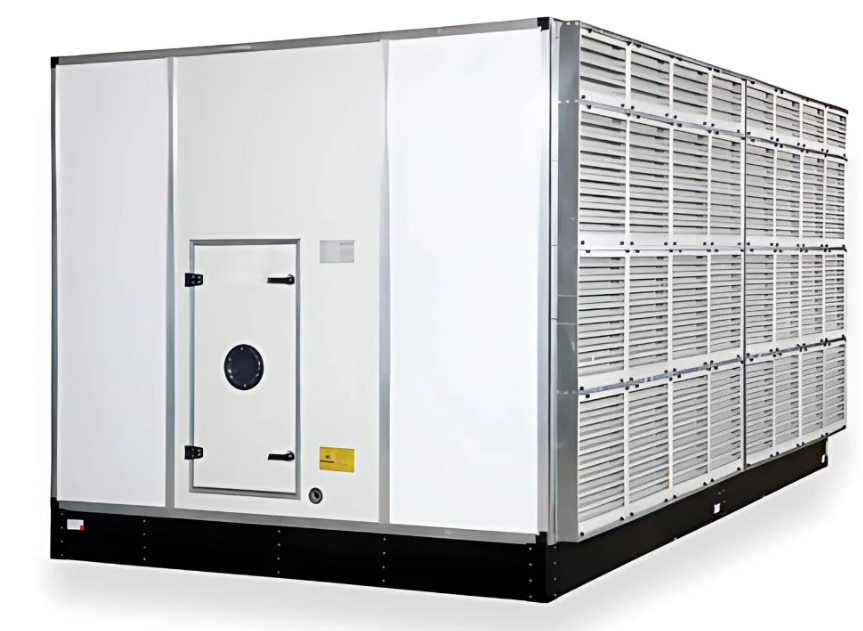 | Sys Enterprises offers advanced Airwashers designed to improve indoor air quality by simultaneously filtering, humidifying, and cooling air. View product → |
Frequently asked questions
What data is needed to define air washer duty?
Provide airflow, entering dry-bulb and wet-bulb temperatures or relative humidity, barometric pressure or elevation, and required leaving conditions at the operating point.
How do you choose an air washer type and filtration stage?
Match the washer configuration and upstream or downstream filtration to the contaminant, particle size, moisture load, hygiene risk, and required leaving-air quality.
What must air washer capacity calculations include?
Calculate design airflow, water circulation and evaporation, fan pressure and power, spray or contact area, tank volume, drift control, and service access.
Which tests belong in air washer commissioning?
Check airflow, temperatures, humidity, fan rotation, spray coverage, pump operation, level controls, water quality, drain performance, alarms, access, and safe shutdown.
Keywords