A reliable selection starts with a measured process description, not a fan rating or a promised removal percentage. By the end, you will know which operating data to collect, how to calculate gas-flow and capacity requirements, which scrubber configuration fits the contaminant, and what to demand in a supplier’s performance guarantee.
Key takeaways
- Define outlet limits, pollutants, averaging periods, gas flow, temperature, and moisture.
- Size the scrubber for actual gas volume at operating temperature and pressure.
- Match the scrubber type to particle size, gas chemistry, pressure drop, and liquid use.
- Demand tested outlet performance, operating limits, utilities, corrosion materials, and guarantees.
What operating data belongs in a wet scrubber design basis?
Begin with the control objective, because wet scrubber requirements depend on the outlet limit and pollutant behaviour, not airflow alone. Identify every pollutant, the required outlet concentration or removal efficiency, and the applicable averaging period.
1. Record gas flow at minimum, normal and peak production. Document inlet temperature, absolute pressure, moisture content, gas composition, operating hours and expected production changes. State whether each flow figure is actual or normalized and whether moisture is reported on a wet or dry basis.
2. For particles, measure inlet concentration and particle-size distribution. Record stickiness, abrasiveness and tendency to scale; these properties determine plugging, erosion, cleaning and demister carryover risks.
3. For each gas contaminant, document concentration, solubility, reaction chemistry, corrosiveness, toxicity and flammability. Confirm that the proposed liquid can dissolve or react with every target compound; otherwise, breakthrough is built into the design.
4. Test whether a wet scrubber fits the process and site. A dry particulate stream may be better served by a dry collector, while a water-sensitive process may reject liquid contact. Without wastewater treatment or a permitted discharge, the site cannot responsibly manage blowdown containing dissolved solids, chlorides, metals, reaction products or suspended solids.
Include startup surges, shutdown conditions and future production in the design basis. A supplier cannot select vessel volume, liquid rate or mist eliminator from a fan rating alone.
How do you calculate wet scrubber size requirements and capacity?
Vessel size starts with actual gas flow at the scrubber inlet, not the fan nameplate. Use minimum, normal and peak actual m³/h, then size the vessel cross-sectional area, superficial velocity, fan and mist eliminator for those conditions.
| Flow figure | What it means | Sizing use |
|---|---|---|
| Actual m³/h | Gas volume at inlet temperature, absolute pressure and moisture content | Determines vessel area, velocity and loading |
| Nm³/h, wet | Normalized volume including water vapour at defined reference conditions | Convert using the stated wet basis |
| Nm³/h, dry | Normalized dry-gas volume excluding water vapour | Add the water-vapour correction before sizing |
For an ideal-gas estimate, Qactual,wet = QN,dry × (Tactual/TN) × (PN/Pactual) ÷ (1 − yw), using absolute temperatures and pressures. TN and PN must be stated; yw is the water-vapour mole fraction at the scrubber inlet. Higher temperature, lower pressure or added vapour increases actual volume, fan duty and demister loading.
- Minimum, normal and peak flow, including startup surges and planned production increases
- Particulate and contaminant loading, operating hours and wastewater generation
- Pump capacity, liquid rate, pressure drop, packing or tray flooding, sump volume and reagent demand
Define turndown as the lowest guaranteed flow. Below it, contact worsens, gas can channel and the demister can malfunction; above peak capacity, the vessel, pump and wastewater system can overload. Require guaranteed minimum and maximum flow, liquid rate, pressure drop and removal performance at each operating point.
Which scrubber configuration matches the pollutant and pressure-drop limit?
Match the industrial wet scrubber to the pollutant, solids loading and allowable pressure drop—not to airflow alone. Wet scrubber selection becomes clearer when each design’s strength and failure mode are explicit.
| Configuration | Best fit | Main trade-off |
|---|---|---|
| Spray tower | Dirty gas and high solids loading | Simple, low-fouling contact but lower mass-transfer efficiency |
| Packed bed | Gas absorption after particulate pre-cleaning | Efficient contact, but plugging, flooding, scaling and fouling can stop performance |
| Venturi | Fine particles or combined particle and gas conditioning | Strong capture at substantially higher pressure drop and fan power |
| Cyclone-spray | Coarse particles | Robust separation with limited absorption area |
| Plate or tray | Staged gas-liquid contact | More controlled stages, with added internal complexity |
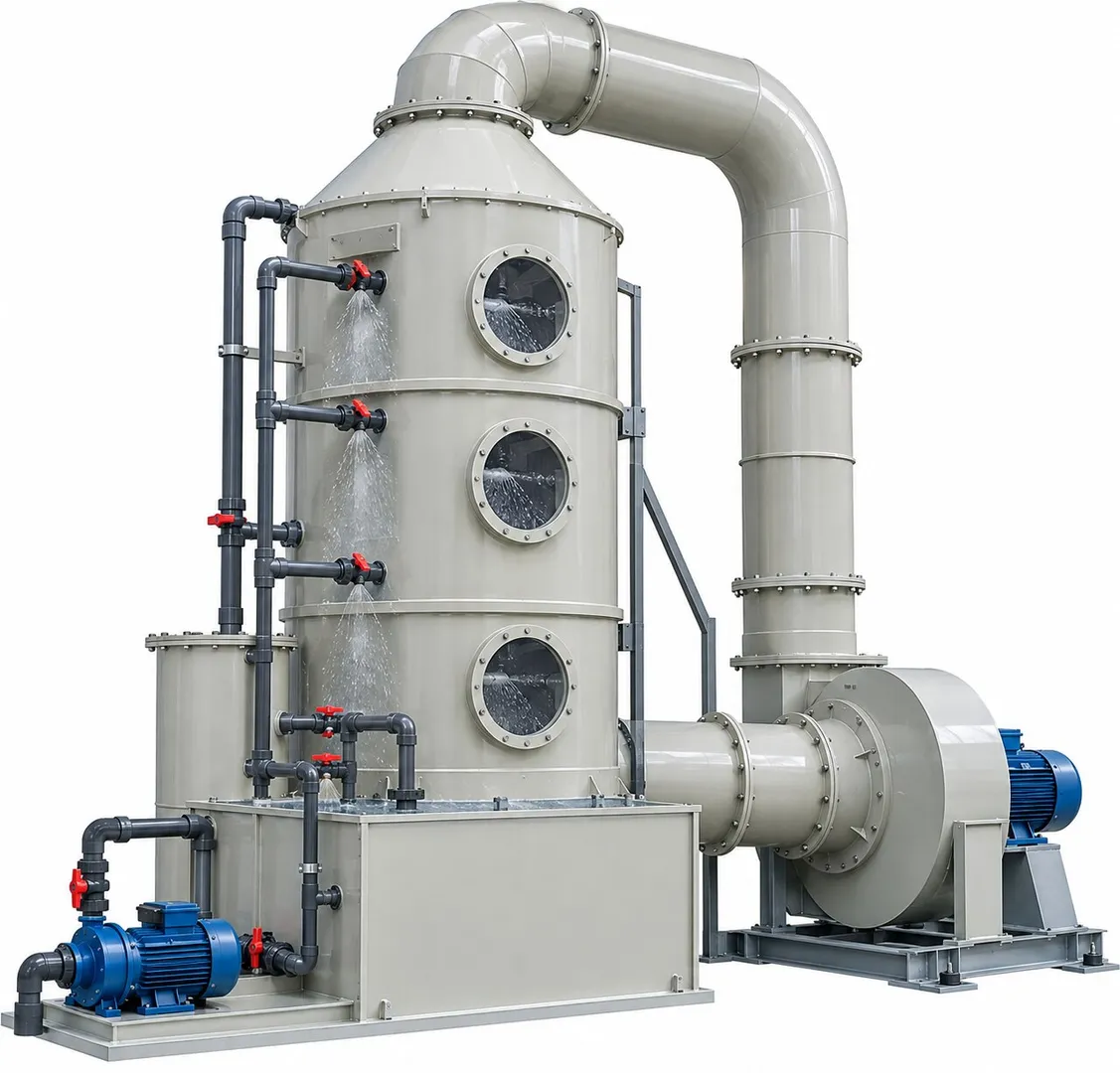
For a packed bed, specify packing type and size, allowable particulate loading, minimum wetting rate, liquid distributors, inspection access, cleaning access and high-differential-pressure alarm or shutdown. Poor distribution causes channeling; excess liquid causes flooding.
Treat pressure drop as a design variable. Require its guaranteed range at the stated gas flow and liquid rate, especially for a venturi, where higher velocity and liquid injection improve fine-particle capture but increase fan energy.
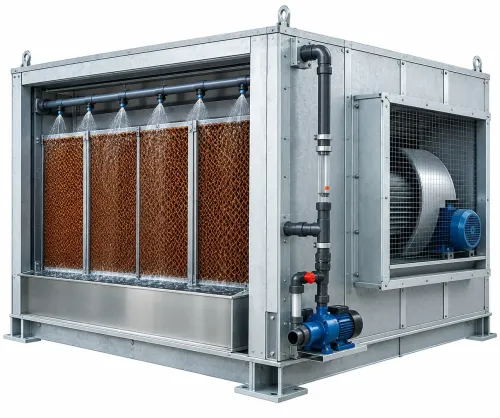
The mist eliminator is a control element, not an accessory. Match it to droplet size, gas velocity, liquid loading, orientation and cleaning method; excessive velocity causes re-entrainment, while fouling raises pressure drop and reduces capacity. Require guarantees for:
- Removal efficiency and outlet concentration
- Pressure drop at minimum, normal and peak flow
- Mist carryover and demister cleaning performance
How should you choose the scrubbing liquid and supporting equipment?
Choose the liquid by the contaminant’s chemistry, not by the industrial wet scrubber’s airflow. Water suits soluble contaminants when pH and reaction demand are modest; alkaline liquor suits acid gases, acidic liquor suits alkaline gases, and a reagent solution suits contaminants requiring a specific reaction.
| Liquid | Best fit | Main control |
|---|---|---|
| Water | Soluble contaminants | pH, temperature and dissolved-solids buildup |
| Alkaline liquor | Acid gases | pH, alkalinity and reagent concentration |
| Acidic liquor | Alkaline gases | pH and acid concentration |
| Reagent solution | Specific chemical reaction | Reagent strength and oxidation-reduction potential |
State the liquid-to-gas ratio, pH range, reagent concentration, oxidation-reduction potential, liquid temperature, residence time, recirculation rate and makeup-water quality. A bulk-tank pH reading does not prove removal: depleted reagent, poor distribution, weak oxidation chemistry or short contact time can cause breakthrough.
Design purge or blowdown to control dissolved solids, chlorides, metals, reaction products and suspended solids. Identify wastewater treatment, permitted discharge limits and hazardous-waste characterization for the resulting liquid or sludge.
Specify materials for the vessel, welds, flanges, drains, pumps, piping, spray headers, nozzles, packing, trays and demister. Corrosion depends on pH, temperature, chlorides, oxidants, abrasion and wet-dry cycling, so concentrated liquor at welds or drains needs particular attention.
Require flow, level, pH or reagent, temperature and differential-pressure instruments. Add interlocks for lost circulation and abnormal pressure drop. For combustible dust or flammable vapour, address static, ignition sources, explosion relief or suppression, and the consequences of a scrubber trip.
What should a supplier guarantee before you approve the system?
Approve a proposal only when the manufacturer gives you a design package and a performance guarantee tied to agreed test conditions. A removal percentage without those conditions cannot be compared between bids.
| Proposal evidence | What to verify | Reject if absent |
|---|---|---|
| Design basis | Actual and normalized gas flow, wet or dry basis, minimum and maximum wet scrubber capacity, peak load, liquid flow, reagent consumption, pressure-drop range and fan power | No defined operating range |
| Equipment schedule | Scrubber configuration, demister type, pump duty, sump volume, materials of construction, instrumentation and maintenance access | No way to inspect, service or confirm suitability |
| Performance guarantee | Inlet concentration or loading; gas flow, temperature, moisture and pressure; liquid chemistry and flow; pressure drop; particle-size range where relevant; outlet concentration or removal efficiency; test averaging basis and scrubber condition during testing | Percentage removal only |
Make the guarantee cover the actual duty, not a laboratory point. For venturi systems, require pressure drop at the specified gas flow and liquid rate because higher collection efficiency also increases fan power.
Ask for written procedures covering:
- Startup, shutdown, loss of power and loss of recirculation
- Bypass restrictions, upset conditions and guaranteed minimum and maximum flow
- Future production, blowdown, sludge handling, cleaning and demister inspection
Sys Enterprises should be evaluated against the same schedule as every other industrial equipment supplier. Compare guaranteed performance, energy, reagent, water, wastewater, inspection and downtime costs—not the largest fan rating or lowest purchase price.
Related product
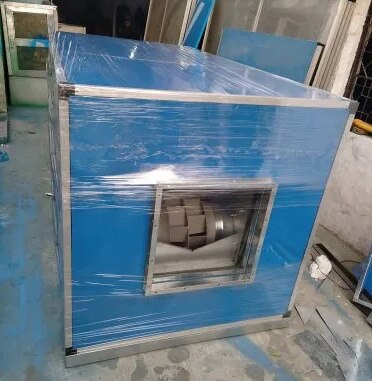 | Sys Enterprises provides efficient Wet Scrubbers designed for effective removal of dust, gases, and pollutants from industrial exhaust streams. View product → |
Frequently asked questions
What operating data belongs in a wet scrubber design basis?
Provide every pollutant, inlet concentration or mass rate, required outlet limit or removal efficiency, averaging period, gas flow range, temperature, pressure, moisture, particle loading, corrosive compounds, operating hours, and upset conditions.
How do you calculate wet scrubber size requirements and capacity?
Convert the gas flow to actual operating conditions, then size the vessel and internals for gas velocity, residence or contact time, liquid-to-gas ratio, pressure drop, droplet separation, and the highest design flow. Include turndown and future load changes.
Which scrubber configuration matches the pollutant and pressure-drop limit?
Use venturi scrubbers for fine particles and high mass-transfer demand when high pressure drop is acceptable. Use packed beds for soluble gases and lower pressure drop, and tray or spray towers when solids, fouling, or simpler maintenance controls the choice.
How should you choose the scrubbing liquid and supporting equipment?
Select water or a chemical reagent based on pollutant solubility, reaction chemistry, pH, temperature, oxidation needs, dissolved solids, corrosion, and waste treatment. Specify pumps, recirculation tanks, dosing, mist eliminators, blowdown, makeup water, instrumentation, and controls.
What should a supplier guarantee before you approve the system?
Require guaranteed outlet concentrations or removal efficiencies at named operating cases, gas-flow and pollutant ranges, pressure drop, liquid consumption, power, noise, mist carryover, materials, test methods, sampling locations, and remedies for missed performance.
Keywords