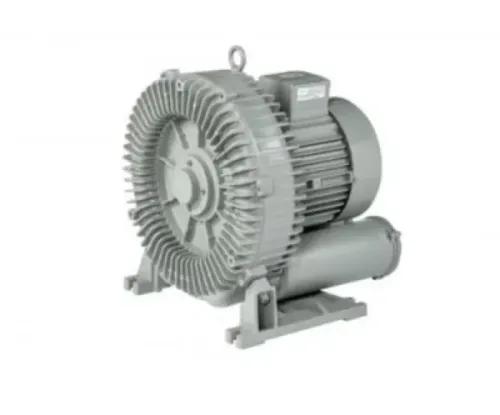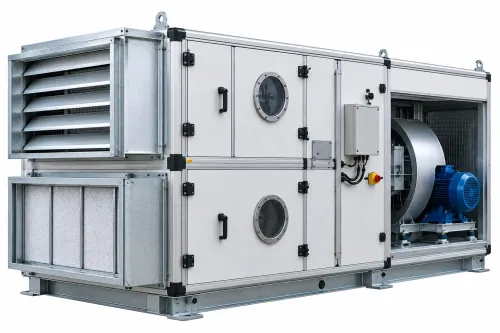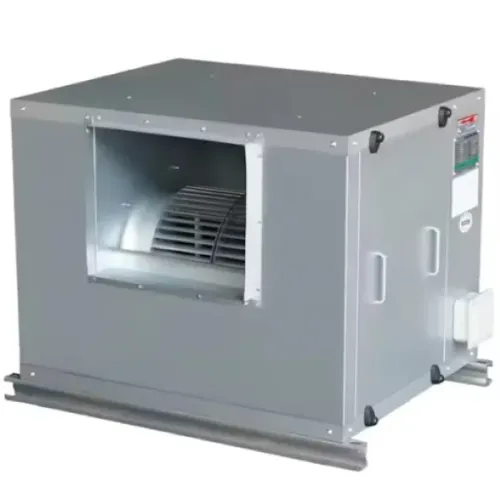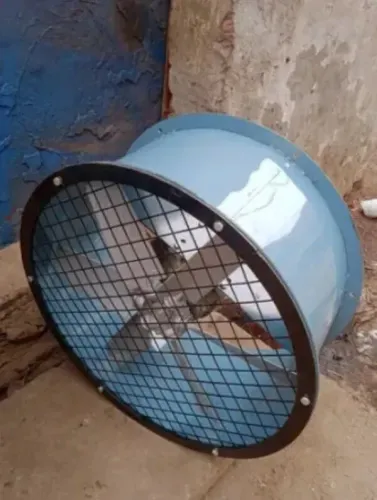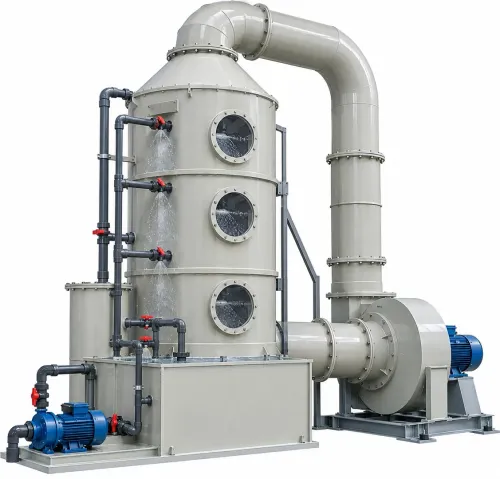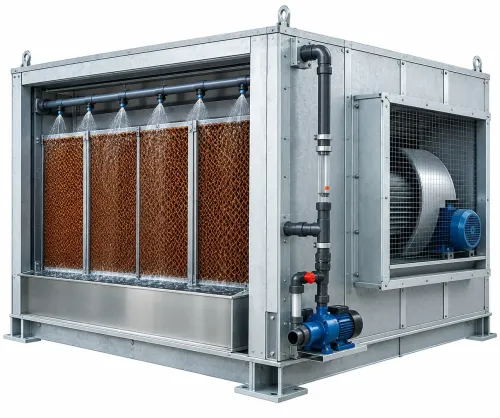
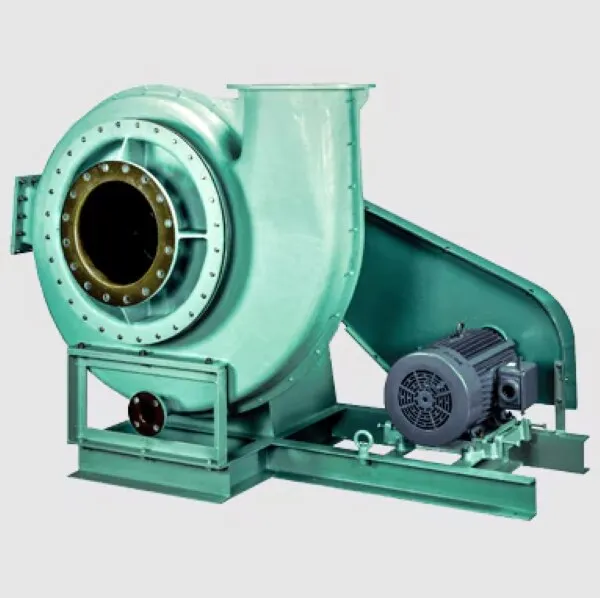
A polypropylene blower is selected by gas chemistry, temperature, pressure and construction details—not by the material name or maximum airflow alone. You will be able to distinguish direct-drive mechanics from belt drive, calculate the real duty point and request specifications that expose temperature, vacuum, speed, safety and maintenance limits.
Key takeaways
- Select the blower from airflow and pressure at the operating duty point.
- Confirm polypropylene compatibility with the process chemicals and exhaust temperature.
- Check motor speed, impeller balance, noise, and ignition risks before purchase.
- Compare efficiency, controls, materials, dimensions, maintenance, and documentation.
How a Polypropylene Direct-Drive Blower Transfers Power
A polypropylene blower direct drive arrangement connects the motor shaft straight to the impeller. It uses no belts, pulleys, sheaves or intermediate shaft, so it removes belt slip and reduces belt tensioning, pulley alignment checks and belt replacement.
Direct drive blowers usually need less routine mechanical service, but they lose the quick mechanical speed changes available by swapping belt sheave ratios.
A variable-frequency drive normally changes motor speed instead. At roughly constant air density, a 10% speed increase produces about 10% more airflow, 21% more pressure and 33% more power. Use those fan-law estimates only within the manufacturer’s approved rpm range and after checking motor load, impeller tip speed, shaft stress and structural limits.
Direct drive does not make the rotating assembly maintenance-free. Keep these checks in the service plan:
- Inspect bearings and shaft seals for wear, leakage and heat.
- Confirm motor cooling at the selected speed, including low-speed VFD operation.
- Check impeller balance after deposits, condensation, chemical attack or erosion.
- Measure vibration against the manufacturer’s allowable limit.
- Verify that the VFD settings cannot exceed approved rpm.
Because impeller speed follows motor speed, a direct-drive unit can have a narrower efficient operating range than a belt-drive unit, especially at low speed. Excessive turndown can reduce efficiency, weaken motor cooling and cause unstable flow; state the required turndown range before selection.
Size the Blower From the System Duty Point
Select the blower at the system duty point, not from airflow alone. State the required actual or standard airflow in m³/h or CFM, then calculate total static pressure in Pa or mmWG for the complete installation.
Include these pressure losses:
- Straight duct, elbows and transitions
- Filters, scrubbers and process equipment at their loaded condition
- Stack losses, discharge fittings and outlet restrictions
The duty point is where the connected-system resistance curve intersects the blower performance curve. A catalog rating such as 5,000 CFM at zero static pressure proves nothing about performance against duct and equipment resistance.
Read the curve by locating the required flow on the horizontal axis, moving to the calculated pressure requirement, and checking that the intersection remains inside the manufacturer’s efficient, stable operating region. Add a system-effect allowance only when the designer’s or vendor’s curve data supports it; an unsupported allowance can oversize the unit.
| Selection basis | What it means | Why it matters |
|---|---|---|
| Catalog airflow | Flow at a stated, often low, resistance | Does not prove installed performance |
| Duty point | Flow and pressure at curve intersection | Represents the connected system |
| Direct-drive selection | Impeller speed tied to motor speed | Turndown and efficiency depend on approved limits |
For polypropylene blowers direct drive selection, provide density inputs for hot, humid, high-altitude or process-gas service:
- Temperature
- Molecular weight
- Elevation
- Moisture content
These values change generated pressure and absorbed power. Record the direct drive blower details alongside the flow and pressure basis.
Match Polypropylene to Chemistry, Temperature and Pressure
Polypropylene blower specifications must name the actual gas, not merely claim “corrosion resistant.” Provide gas constituents, concentration, temperature, exposure time and operating pressure; resin grade and mechanical stress change resistance.
Flag these chemistry risks for explicit review:
- Oxidizing acids can attack the resin.
- Halogens can cause embrittlement or chemical attack.
- Aromatic solvents can swell or weaken polypropylene.
- Chlorinated solvents can cause swelling, cracking or loss of strength.
A commonly encountered continuous-use limit is about 180°F (82°C) or below. Pressure, vacuum, chemical exposure, speed, the selected PP compound and welded construction can reduce that limit, so request the supplier’s pressure-temperature curve for the exact industrial polypropylene blower.
| Part | Specify | Why it matters |
|---|---|---|
| Gas-side casing and impeller | PP compound, wall thickness and construction | Determines chemical and mechanical resistance |
| Shaft and penetration | Shaft material or coating, seal material and leakage-control method | Prevents gas reaching bearings or the motor |
| Bearings and motor | Bearing location and motor isolation | Separates process gas from vulnerable components |
| Fasteners and support frame | Material and finish | Prevents external corrosion and structural loss |
Welded joints, reinforcement, wall thickness and impeller construction establish allowable positive pressure and vacuum. A polypropylene casing is not automatically suitable for negative-pressure service; ask for both ratings at the stated temperature, speed and support conditions.
Check Speed, Balance, Noise and Ignition Hazards
1. Require complete polypropylene blower specifications before acceptance: impeller diameter, approved rotational-speed range, motor power, allowable tip speed, efficiency, overall dimensions, weight, positive-pressure rating and vacuum rating. Record the duty-point airflow, pressure and gas density against these values.
2. Treat fan laws as estimates between tested points, not permission to increase rpm. A 10% speed rise predicts about 10% more flow, 21% more pressure and 33% more power, but excess speed can exceed shaft, bearing, motor, impeller or casing limits.
3. Request the balancing grade or balancing procedure, allowable vibration, bearing arrangement and a practical inspection and cleaning method. Scrubber deposits, dust, condensation, chemical attack and erosion can change rotating mass and create vibration despite direct drive.
4. Specify noise using the measurement standard, operating point, microphone distance or sound-power basis, and octave-band data when required. Direct drive can remove belt noise; it does not remove blade-passing noise, turbulence, high-tip-speed noise or flow separation.
5. Treat polypropylene as nonconductive, not explosion-proof or intrinsically safe. For flammable vapour or combustible dust, require a documented hazard review covering classification, grounding, bonding, ignition sources, motor and electrical equipment, and the applicable installation standard, such as NFPA 70 or IEC 60079 where applicable. Keep these direct drive blower details with the purchase record.
Turn the Specification Into a Comparable Purchase Decision
A comparable RFQ starts with identical duty data, not identical casing labels. For a polypropylene blower direct drive selection, give every supplier the same airflow, static pressure, chemistry, temperature, density basis and operating hours.
- Request a duty-point curve showing airflow, static pressure, efficiency, power, rpm, temperature and gas-density basis, plus approved turndown and VFD limits.
- Request construction drawings identifying gas-side and non-gas-side materials, weld or molding details, support-frame material, shaft penetration, seals, bearings, motor isolation, access panels and drains.
- Request noise data, balancing records, vibration limits, inspection access, spare-part requirements and commissioning checks.
| Option | Site advantage | Trade-off to compare |
|---|---|---|
| Direct drive | Fewer belt-tensioning, alignment and replacement tasks | Speed depends on motor rpm and VFD limits |
| Belt drive | Easier mechanical speed changes through sheave ratios; different motor-access arrangements | Adds belts, pulleys, alignment checks and belt service |
Judge both arrangements at the actual installation. A manufacturer’s engineering support adds value by converting your airflow, static pressure, gas chemistry, temperature and operating hours into a documented selection, rather than guessing from horsepower. Sys Enterprises is worth comparing when it returns that evidence in a complete, reviewable package.
The winning industrial polypropylene blower is not the one with the most persuasive casing description. It is the one whose curve, materials, limits and commissioning checks survive your operating conditions.
Related products
 | Sys Enterprises specializes in corrosion-resistant Polypropylene Blowers, available in both Direct Drive and Belt Drive configurations. View product → |
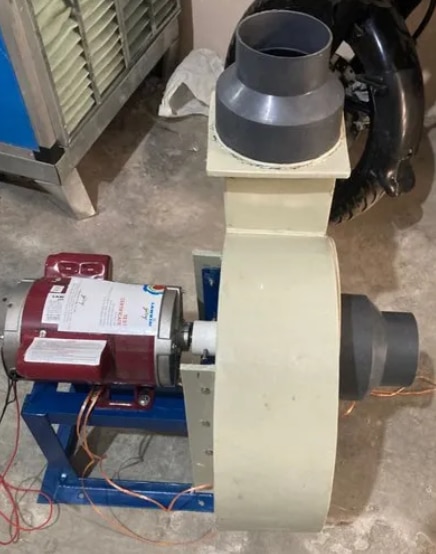 | Centrifugal blowers Polypropylene Centrifugal Blower ₹17000 Polypropylene (PP) Centrifugal Blower Manufacturer & Supplier We are a trusted manufacturer and supplier of Polypropylene (PP) Centrifugal Blowers,... View product → |
Frequently asked questions
How does a polypropylene direct-drive blower transfer power?
The motor shaft connects directly to the impeller, eliminating belts, pulleys, sheaves, and an intermediate shaft.
How do you size a polypropylene blower?
Use the system duty point: required airflow at the total pressure, including duct, fitting, filter, hood, and discharge losses.
When is polypropylene suitable for a blower?
Check polypropylene’s resistance to the specific chemicals, gas concentration, temperature, pressure, and operating conditions.
What should you check before buying a direct-drive blower?
Verify speed, impeller balance, noise, ignition hazards, motor details, construction, dimensions, controls, efficiency, and documentation.
Keywords