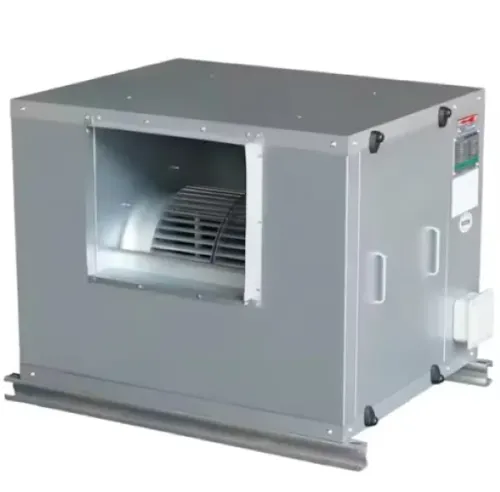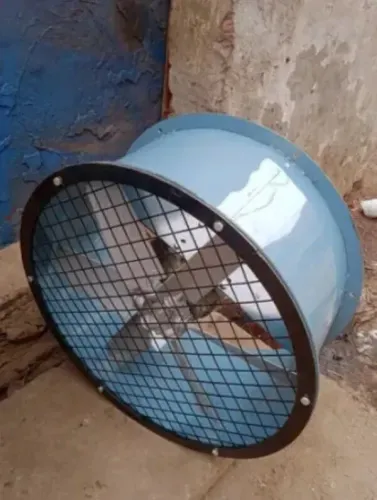
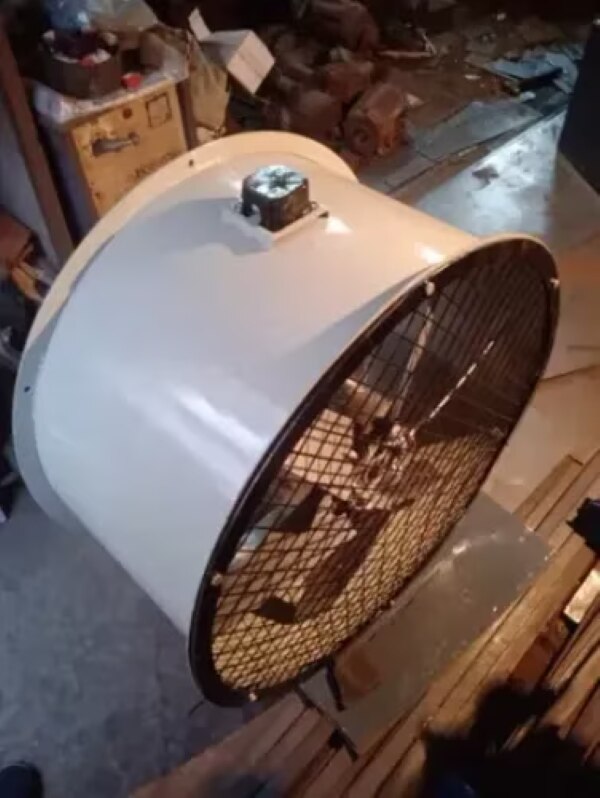
An MS axial fan moves air by accelerating it parallel to the shaft, but its delivered airflow depends on pressure resistance, duct geometry, air density and fan speed. By the end, you will be able to distinguish axial from centrifugal airflow, judge whether mild steel suits the environment, read a performance curve and specify a maintainable fan duty.
Key takeaways
- Match fan selection to airflow, pressure loss and the system’s operating point.
- Specify mild steel with a coating suited to moisture, heat and corrosive exposure.
- Inspect blades, bearings, guards and fasteners before vibration causes a failure.
- Balance the impeller and isolate the fan when performing maintenance.
How an axial impeller turns rotation into airflow
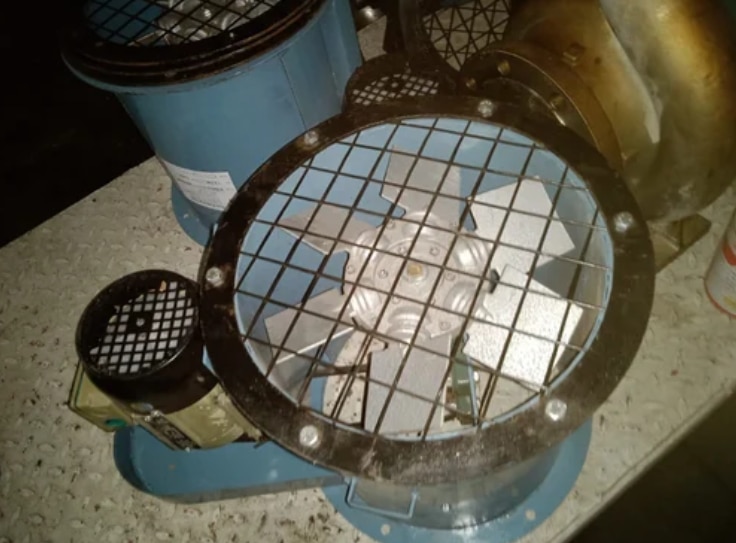
An impeller converts motor torque into air movement by accelerating air mainly parallel to the shaft. Its angled blades create a pressure difference across the rotor: air enters the inlet, gains axial velocity as it passes through the blade field, and leaves through the outlet.
The housing contains and guides this stream so the fan can deliver industrial axial fan airflow into connected equipment.
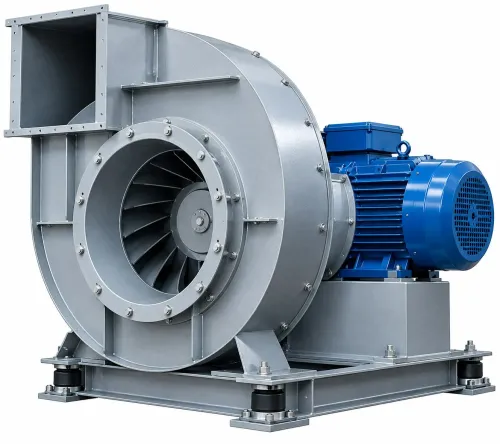
Axial fan | Centrifugal fan Air path | Parallel to the shaft | Turns outward from the shaft Best fit | High volume at low-to-moderate static pressure | Higher static pressure and restrictive duct systems Main limitation | Performance falls quickly as system resistance rises | Requires more space and often more power for the same direct-through airflow
The outlet does not guarantee the catalog flow. Duct resistance shifts the operating point to the intersection of the fan curve and the system curve; a free-air rating can therefore overstate delivered flow. Compare ratings tested on the same basis, such as AMCA Standard 210, which covers fan airflow, pressure, power and efficiency.
A variable-frequency drive changes the operating point, but the fan must remain within its mechanical and motor limits. For similar operation, a 10% speed increase produces about 10% more airflow, 21% more pressure and 33% more power.
MS axial fans still require a tested fan curve: “MS” identifies mild-steel construction, not airflow capacity, efficiency or pressure class.
What mild steel changes in the fan and its service environment
A mild steel axial fan suits dry, non-corrosive general ventilation where its casing and impeller face ordinary temperatures, moisture and particle loads. “Mild steel” describes construction, not airflow performance: confirm the required duty from a tested fan curve, because the material does not guarantee pressure, efficiency or noise.
Choose it when:
- The air is clean or only lightly dusty, with no corrosive vapour or salt loading.
- The fan is indoors, or protected from rain and persistent condensation.
- The priority is economical fabrication and straightforward repair rather than maximum corrosion resistance.
Unprotected mild steel rusts when moisture or chemical contamination reaches the surface. Rust reduces section thickness, roughens blade and casing surfaces, and can seize fasteners or bearings; on an impeller, corrosion and deposits can also destroy balance and reduce airflow.
Outdoor installation, washdown and persistently humid exhaust therefore shorten service life unless the construction and maintenance plan matches the exposure.
A compatible coating or zinc treatment can extend life, but it is not automatically corrosion-proof. Specify protection for the actual contaminant, operating temperature, surface preparation and cleaning method; a damaged finish exposes steel at scratches and edges.
For abrasive dust, inspect blade erosion and buildup. Combustible dust or flammable gas requires a hazardous-location and ignition-control assessment, not an ordinary mild steel axial fan selection. Where corrosion, abrasion or heat dominates, stainless steel, a lined construction or another material can provide the longer-lived choice.
How duct resistance determines the fan’s real operating point
Select the fan at the intersection of the required duty point and the manufacturer’s tested fan curve, not at its free-air maximum. The duty point combines the required airflow with the static pressure the system imposes at that airflow.
Build the system resistance from the actual installation. In MS axial fan operation, the impeller’s pressure rise must overcome every restriction before air reaches the discharge.
Record these inputs before comparing models:
- Required airflow at the process condition, such as m³/h or m³/s
- Required static pressure, with the measurement points clearly defined
- Duct dimensions and length
- Filter, damper, grille and discharge-fitting pressure losses
- Air temperature, density, altitude and contaminant loading
Plot the system curve against the fan curve. Their intersection is the real operating point; a fan rated for 20,000 m³/h in free air can deliver far less through a restrictive duct.
Check that this intersection sits inside the manufacturer’s stable operating region, because stall or surge can produce pulsation, vibration, abnormal noise and changing motor load.
Treat industrial axial fan airflow ratings as comparable only when the test basis matches. AMCA Standard 210 covers fan airflow, pressure, power and efficiency testing; AMCA 500-D covers damper testing. Confirm whether pressure means static or total pressure, and ask for the curve at the selected speed and air density.
A speed change also changes the duty: airflow follows speed, pressure follows speed squared and power follows speed cubed. Check motor capacity before increasing speed.
How to turn a process requirement into a defensible fan specification
Give the manufacturer a duty point, not only a required airflow. A defensible MS axial fan specification states the volume flow, external static pressure, gas condition and stable operating region required at that point. Selecting from the maximum-airflow figure can place the fan in stall, causing pulsation, abnormal noise, vibration and changing motor load.
Provide these details with your enquiry:
- Required airflow in m³/h or m³/s, static pressure in Pa, and whether the pressure is measured at the fan inlet, outlet or across the system.
- Gas temperature, altitude, composition, moisture, dust loading and operating pressure; hot air reduces pressure capability, while dense or pressurised gas increases shaft power.
- Duct diameter, filters, dampers, elbows, discharge fittings, inlet restrictions and the expected operating range.
- Continuous duty, start-stop frequency, ambient conditions, noise limit, hazardous-area classification and corrosion exposure.
- Direct-drive or belt-drive preference, motor voltage and frequency, speed-control requirement, and the manufacturer’s fan curve, motor curve and efficiency data.
Compare quotations on the same basis:
| Option | What to compare | Why it matters |
|---|---|---|
| Direct drive | Speed, motor rating, service access | Removes belts but limits speed adjustment |
| Belt drive | Belt guard, sheaves, tension and alignment data | Allows speed changes but adds losses and maintenance |
| VFD-controlled | Approved speed range, minimum cooling speed and resonance limits | Airflow control cannot replace curve and motor checks |
Ask Sys Enterprises to state the quoted fan’s duty-point pressure, gas-density correction, motor margin and stable operating range. Those figures let you compare MS axial fans rather than comparing free-air ratings. Confirm that MS axial fan operation remains within the specified envelope after filters load up.
Related products
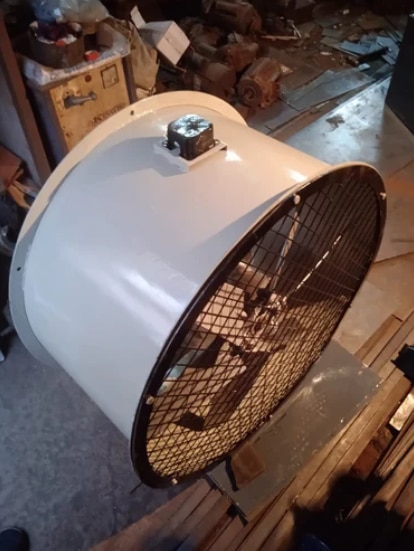 | Axial Flow Fans ₹14000 Premium MS Axial Flow Fans Manufacturer & Supplier We are a leading manufacturer and supplier of MS Axial Flow Fans designed to deliver powerful... View product → |
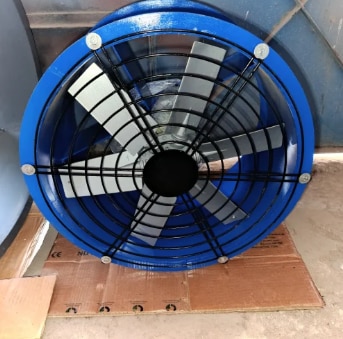 | Axial Flow Fans ₹10000 Industrial Axial Fan Manufacturer & Supplier We are a leading manufacturer and supplier of Industrial Axial Fans, designed to provide efficient air... View product → |
How to keep the fan stable, balanced and safe in service
A stable fan starts with isolation: use the site’s lockout/tagout energy-control procedure before opening guards or entering the housing, including stored electrical and rotating energy. Effective MS axial fan maintenance then checks fasteners, guards, bearings, shaft supports, impeller condition and housing clearances.
| Drive arrangement | Maintenance focus | Main trade-off |
|---|---|---|
| Direct drive | Check motor bearings, mounting, rotation, impeller fouling and balance | No belts or sheaves; speed changes require motor-control and curve checks |
| Belt drive | Check belt wear, tension, sheave alignment, guards and bearing condition | Adjustable speed, but slip, misalignment and overload become risks |
After cleaning or repairing, rotate the impeller by hand where safe, verify rotation and restart behind guards. Stop and investigate rising vibration, scraping, rattling, pulsating airflow, fluctuating motor current, overheating or visible blade cracks, corrosion, deposits and looseness. Deposits can unbalance the rotor; a loose fastener can become a projectile.
- Correct fouling, damaged blades, worn bearings, loose supports and belt defects before returning the fan to service.
- Treat fluctuating airflow, pressure pulsation and rapidly changing motor load as possible stall or surge; compare the duty point with the manufacturer’s stable operating region.
- Do not increase speed casually. Fan power rises approximately with speed cubed, so a larger sheave or VFD setting can overload the motor and raise blade stress, noise and vibration.
- Recheck performance after changes using the actual gas temperature, density and contamination, not a standard-air curve alone.
Frequently asked questions
How does an MS axial fan move industrial air?
Its angled impeller blades accelerate air mainly parallel to the shaft, creating a pressure difference that produces axial airflow.
What does mild steel change in an axial fan?
Mild steel affects the fan’s corrosion resistance, coating requirements, durability and suitability for the service environment.
Why does duct resistance matter when selecting an axial fan?
Duct resistance determines the pressure the fan must overcome, which fixes its real operating point and delivered airflow.
What should an MS axial fan specification include?
State the required airflow, total pressure, air temperature, gas composition, fan materials, motor details, noise limits and safety features.
How do you keep an MS axial fan safe and stable?
Inspect and balance the impeller, check bearings and fasteners, maintain guards, control vibration and isolate power before servicing.
Related products
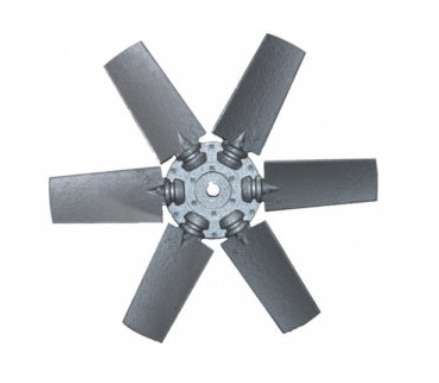 | Impeller Our Axial Fan Blades are engineered for maximum airflow efficiency and durability in industrial and commercial ventilation systems. View product → |
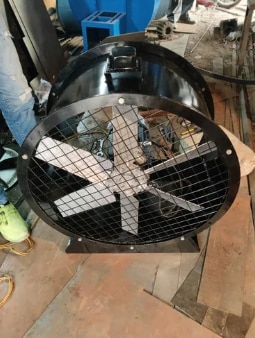 | Axial Flow Fans ₹14000 High-Performance Vane Axial Fan Manufacturer & Supplier We are a leading manufacturer and supplier of Vane Axial Fans designed for high-volume... View product → |
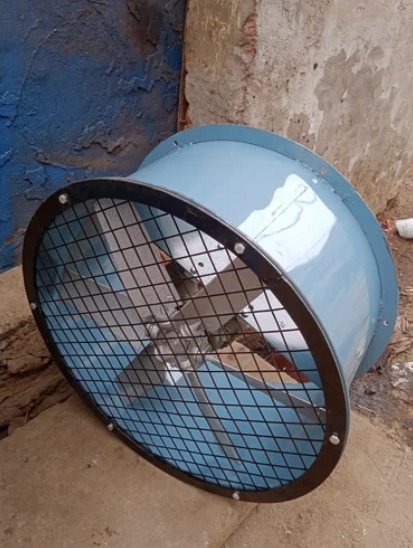 | Axial Flow Fans Industrial Tube Axial Exhaust Fans ₹14000 Industrial Tube Axial Exhaust Fan Manufacturer & Supplier We are a trusted manufacturer and supplier of Industrial Tube Axial Exhaust Fans, offering... View product → |
 | Axial Flow Fans ₹18000 Manufacturer & Supplier SYS ENTERPRISES is a leading manufacturer and supplier of Belt Drive Axial Flow Fans, designed to deliver high-volume airflow... View product → |
Keywords